
Settings
Timing's settings control what it tracks and how it shows your time. To open them, choose Timing > Settings… or press ⌘,. This page goes through the panes in the order of the sidebar.
A setting that your plan doesn't include shows a grey badge with the name of the plan that does.
Table of Contents
General
Open in Timing →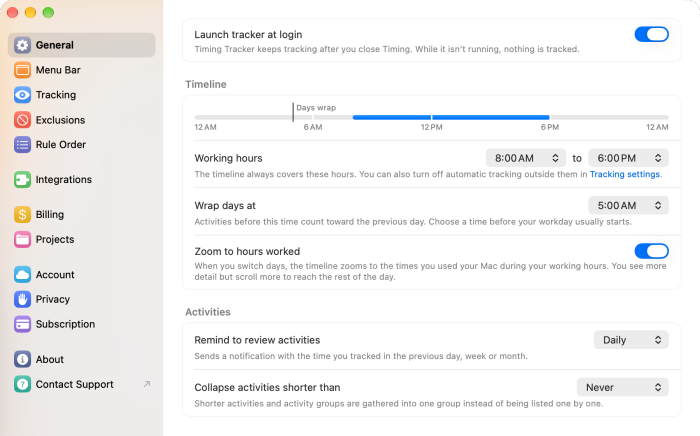
- Launch tracker at login: Timing Tracker keeps tracking after you close Timing. While it isn't running, nothing is tracked, so we recommend keeping this on.
- Working hours: The timeline always covers these hours, so you can create time entries in them even when you didn't use your Mac. You can also turn off automatic tracking outside them in Tracking settings.
- Wrap days at: Activities before this time count toward the previous day. Choose a time before your workday usually starts, for example 5 AM if you often work past midnight.
- Zoom to hours worked: When you switch days, the timeline zooms to the times you used your Mac during your working hours. You see more detail but scroll more to reach the rest of the day.
- Remind to review activities: Sends a notification with the time you tracked in the previous day, week or month.
- Collapse activities shorter than: Shorter activities are gathered into one group instead of being listed one by one.
Menu Bar
Open in Timing →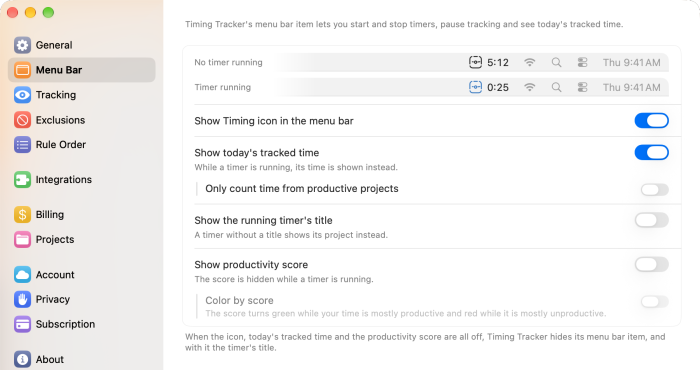
Timing comes with a built-in tracker app that runs in the background and records your app usage. This tracker app can show a menu bar item that lets you start and stop timers, pause tracking and see today's tracked time at a glance. In these settings, you can customize what exactly it shows, with a preview of what the menu bar item will look like.
- Show Timing icon in the menu bar: The icon on its own, or next to the time and the score.
- Show today's tracked time: While a timer is running, its time is shown instead. With Only count time from productive projects, the time covers only projects whose productivity rating is above 0.
- Show the running timer's title: A timer without a title shows its project instead.
- Show productivity score: The score is hidden while a timer is running. Color by score turns it green while your time is mostly productive and red while it is mostly unproductive.
When the icon, the tracked time and the score are all off, Timing Tracker hides its menu bar item, and with it the timer's title.
Tracking
Open in Timing →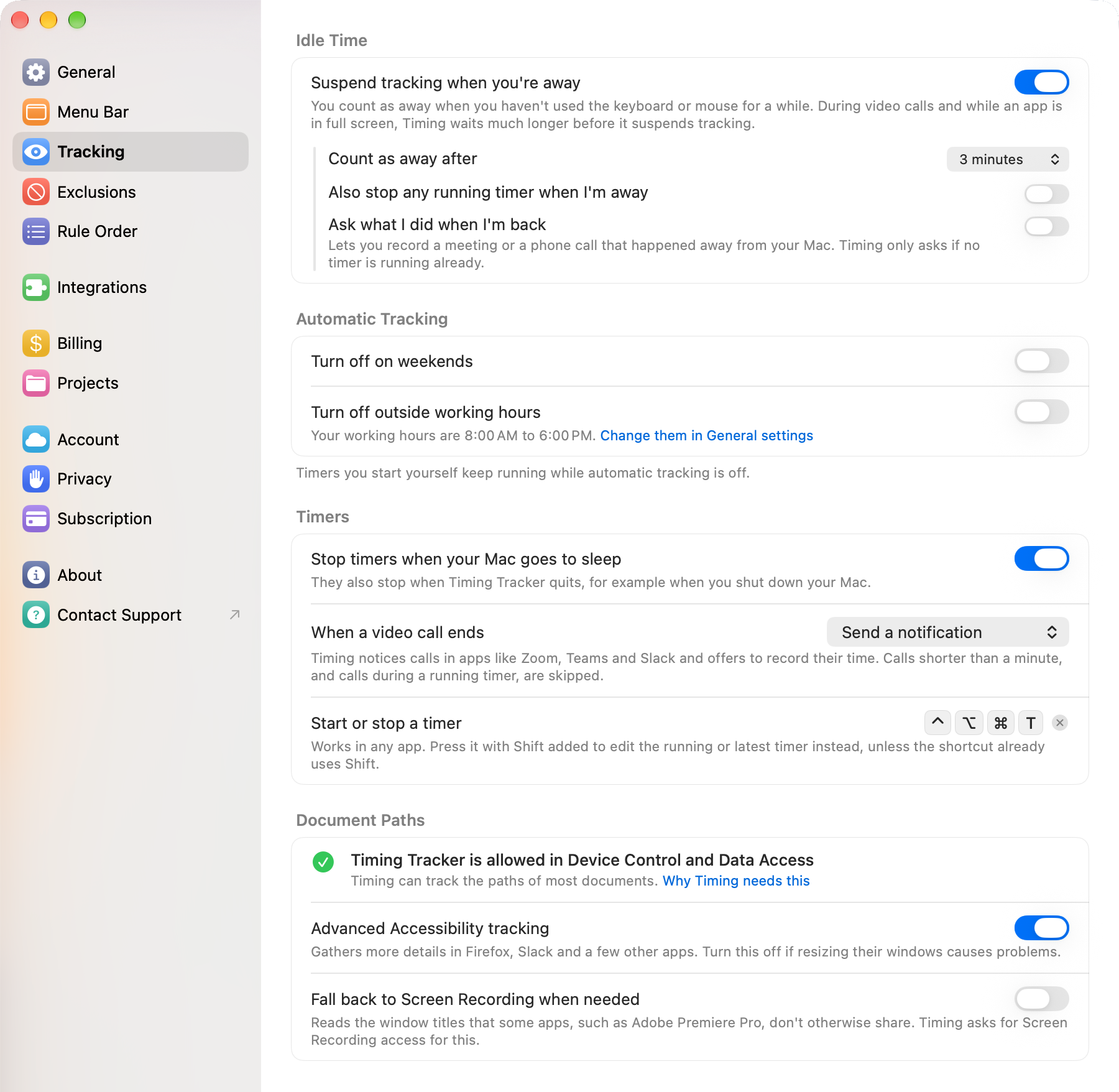
-
Suspend tracking when you're away: You count as away when you haven't used the keyboard or mouse for the time set in Count as away after. During video calls and while an app is in full screen, Timing waits much longer before it suspends tracking.
- Also stop any running timer when I'm away stops timers as well.
- Ask what I did when I'm back lets you record a meeting or a phone call that happened away from your Mac. Timing only asks if no timer is running already.
- Automatic Tracking: Turn off tracking on weekends, outside your working hours, or both. Timers you start yourself keep running.
- Stop timers when your Mac goes to sleep: Timers also stop when Timing Tracker quits, for example when you shut down your Mac. With this off, a timer you forget to stop can keep running for up to 24 hours.
- When a video call ends: Timing notices calls in apps like Zoom, Teams and Slack and can send a notification or open a time entry editor to record the call. Calls shorter than a minute, and calls during a running timer, are skipped. Learn more about call tracking
- Start or stop a timer: This keyboard shortcut works in any app. Add ⇧ to edit the running or latest timer instead, unless the shortcut already uses ⇧.
- Advanced Accessibility tracking: Gathers more details in Firefox, Slack and a few other apps. Turn this off if resizing their windows causes problems.
- Fall back to Screen Recording when needed: Reads the window titles that some apps, such as Adobe Premiere Pro, don't otherwise share. Timing asks for Screen Recording access for this. Learn more about Screen Recording
Exclusions
Open in Timing →Rules that decide which app activities Timing records on this Mac. Activities it recorded earlier stay as they are. Learn how to set up exclusions
Rule Order
Open in Timing →Timing assigns each new app activity to the first project whose rules match it, from the top of this list down. Drag projects with specific rules above projects with broad ones. Learn more about the rule order
Integrations
Open in Timing →Your integrations with their status, the ones you can add (Calendar, Phone Calls, Reminders, Screen Time, ClickUp, Linear and Clio), and the MCP server for AI agents. Each integration has its own page, where you set it up and change its options. Learn more about integrations
Billing
Open in Timing →
- Track billing status: Lets you mark time entries as not billable, billable, billed or paid, and filter reports by their status. When this is off, Timing hides billing status in editors, menus and report filters.
- Default for new time entries: The billing status a new time entry starts with. A default set on a project, or on its team, takes precedence. Learn more about billing status
Projects
Open in Timing →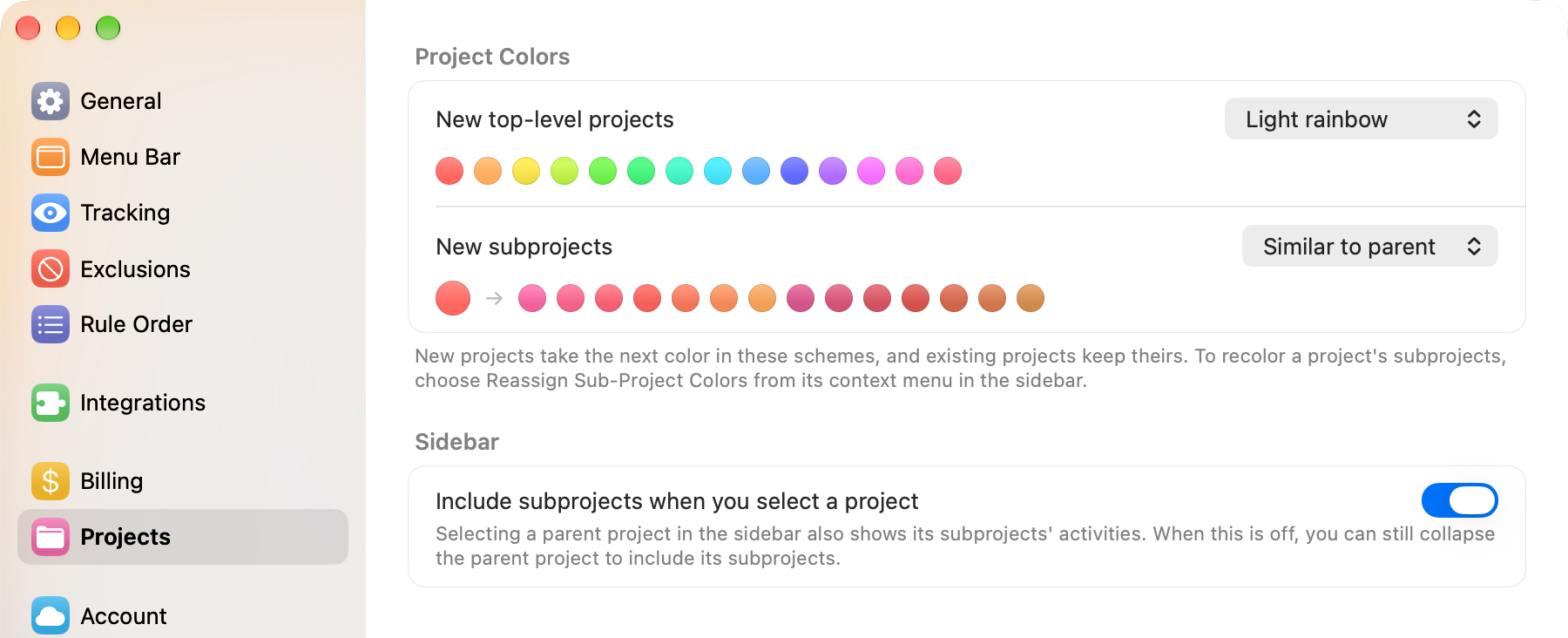
- Project Colors: New top-level projects and new subprojects take the next color from these schemes. Subprojects can use the same color as their parent, a similar one, or the next color of the rainbow. Existing projects keep their colors. To recolor a project's subprojects, choose Reassign Sub-Project Colors from its context menu in the sidebar.
- Include subprojects when you select a project: Selecting a parent project in the sidebar also shows its subprojects' activities. When this is off, you can still collapse the parent project to include its subprojects.
Account
Open in Timing →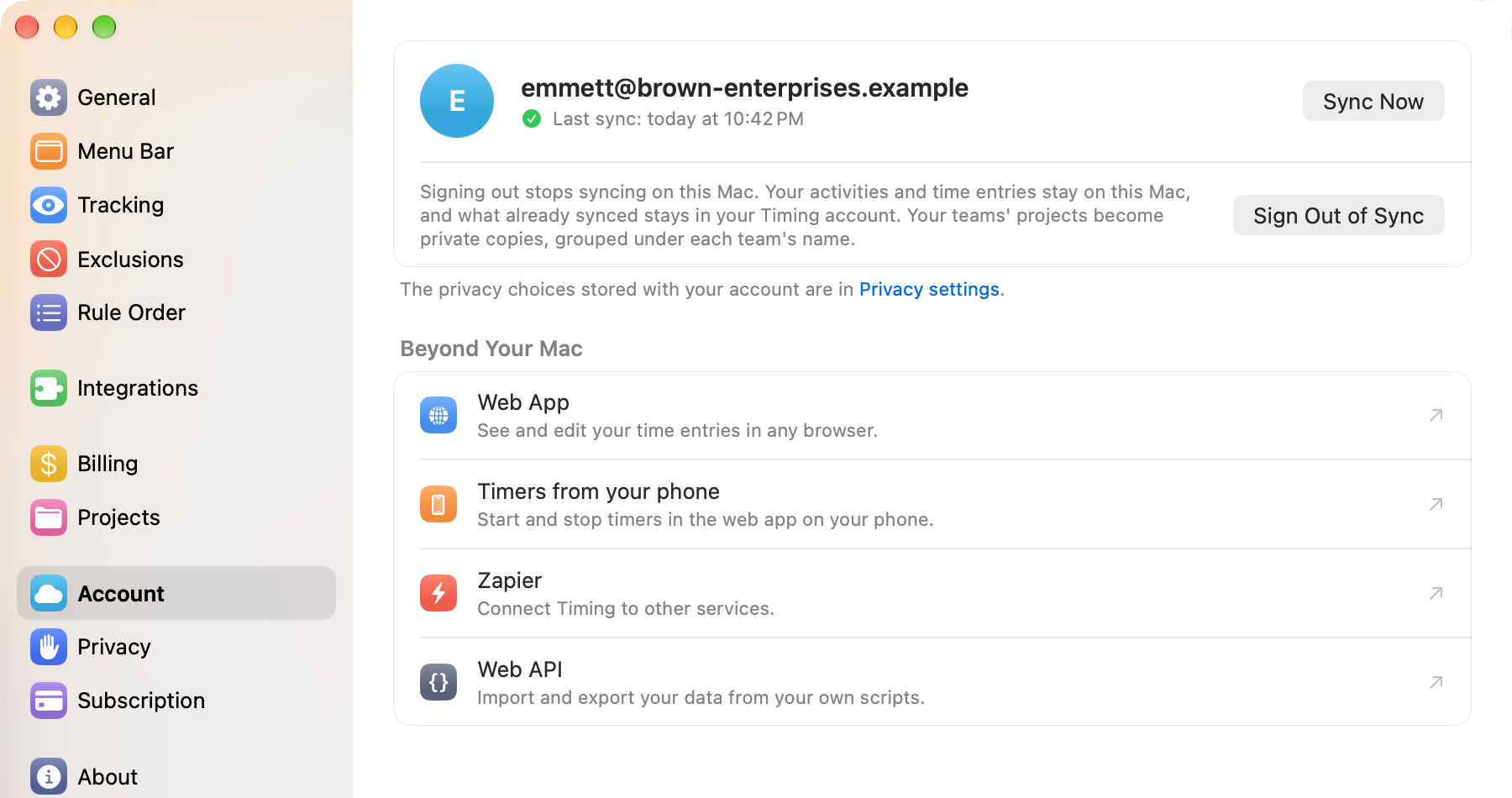
Sign in to Timing Sync to sync your app usage, time entries, projects and filters across your Macs and keep a backup of them online. Learn how to set up Timing Sync
Once you are signed in, Sync Now syncs this Mac right away.
Under Beyond Your Mac, the pane lists what else your Timing account gives you: the web app, timers from your phone, Zapier and the Web API.
Privacy
Open in Timing →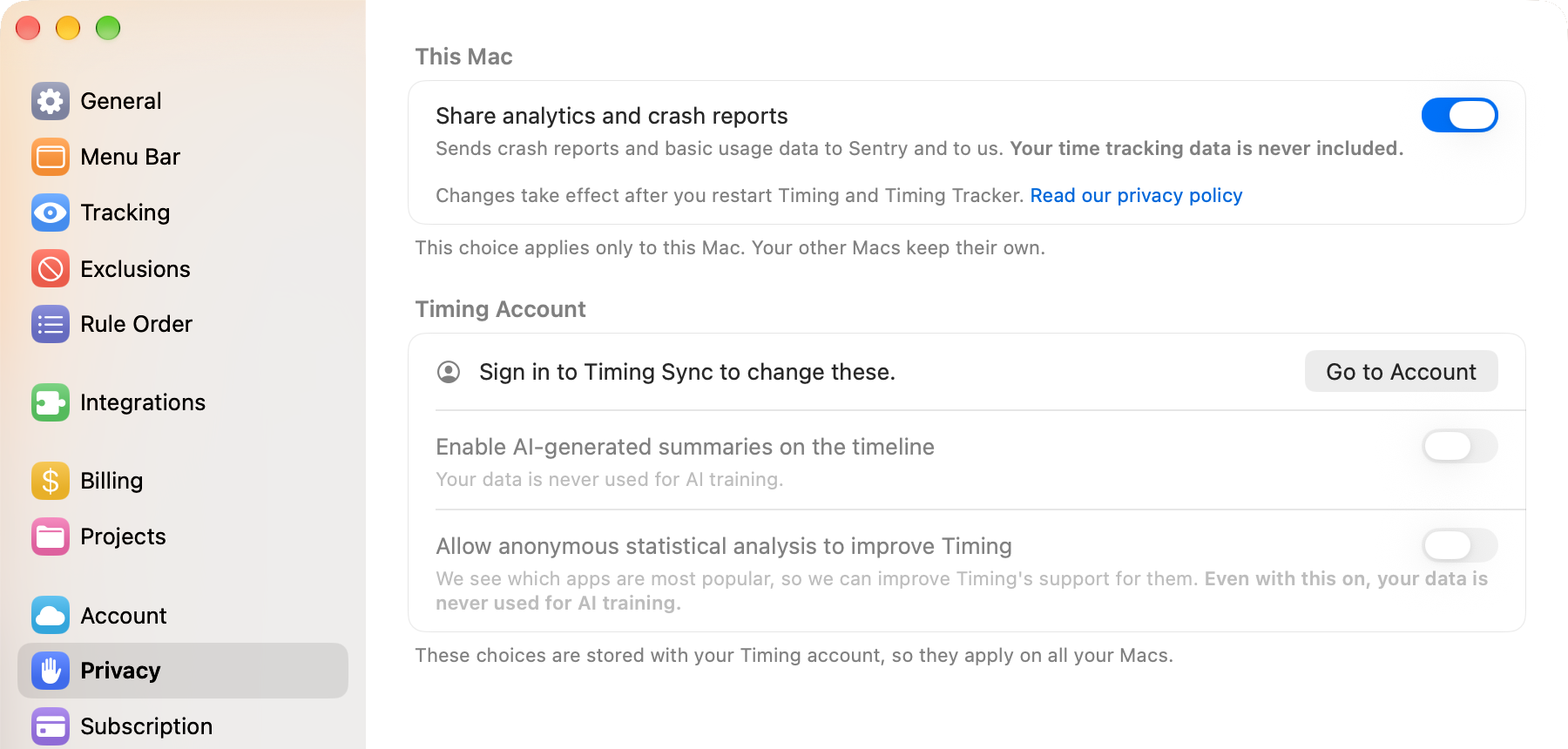
- Share analytics and crash reports: Sends crash reports and basic usage data to Sentry and to us. Your time tracking data is never included. This choice applies only to this Mac, and changes take effect after you restart Timing and Timing Tracker. Read our privacy policy
-
The choices under Timing Account are stored with your account, so they apply on all your Macs. Sign in to Timing Sync to change them.
- Enable AI-generated summaries on the timeline: Turns on AI summaries of your activities.
- Allow anonymous statistical analysis to improve Timing: We see which apps are most popular, so we can improve Timing's support for them.
Subscription
Open in Timing →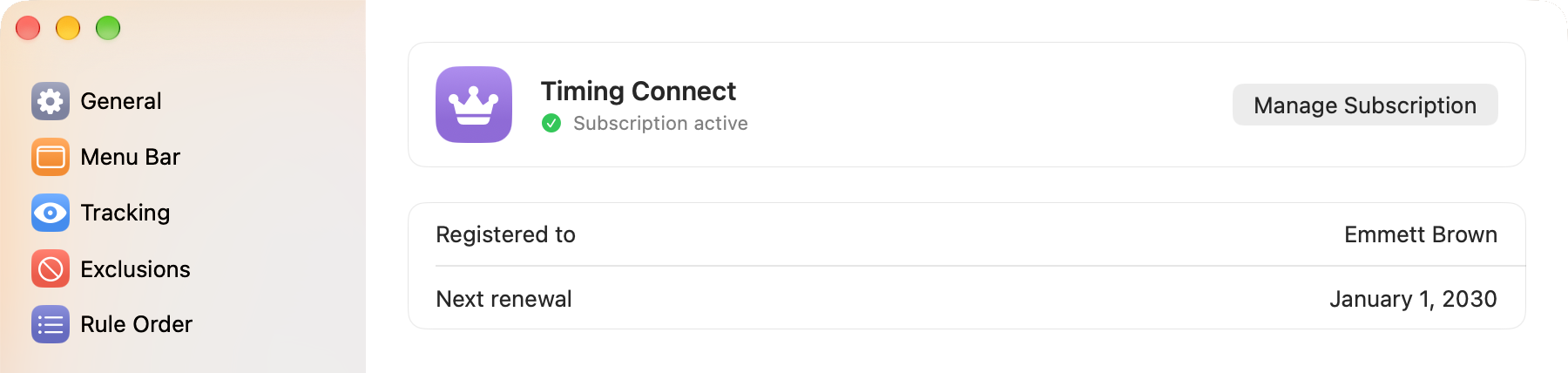
Your plan and its status: the days left in your trial or the next renewal of your subscription. Manage Subscription opens the page where you change or cancel your subscription. To use a subscription or license you already bought, click Activate an existing subscription or license. Compare the plans
About
Open in Timing →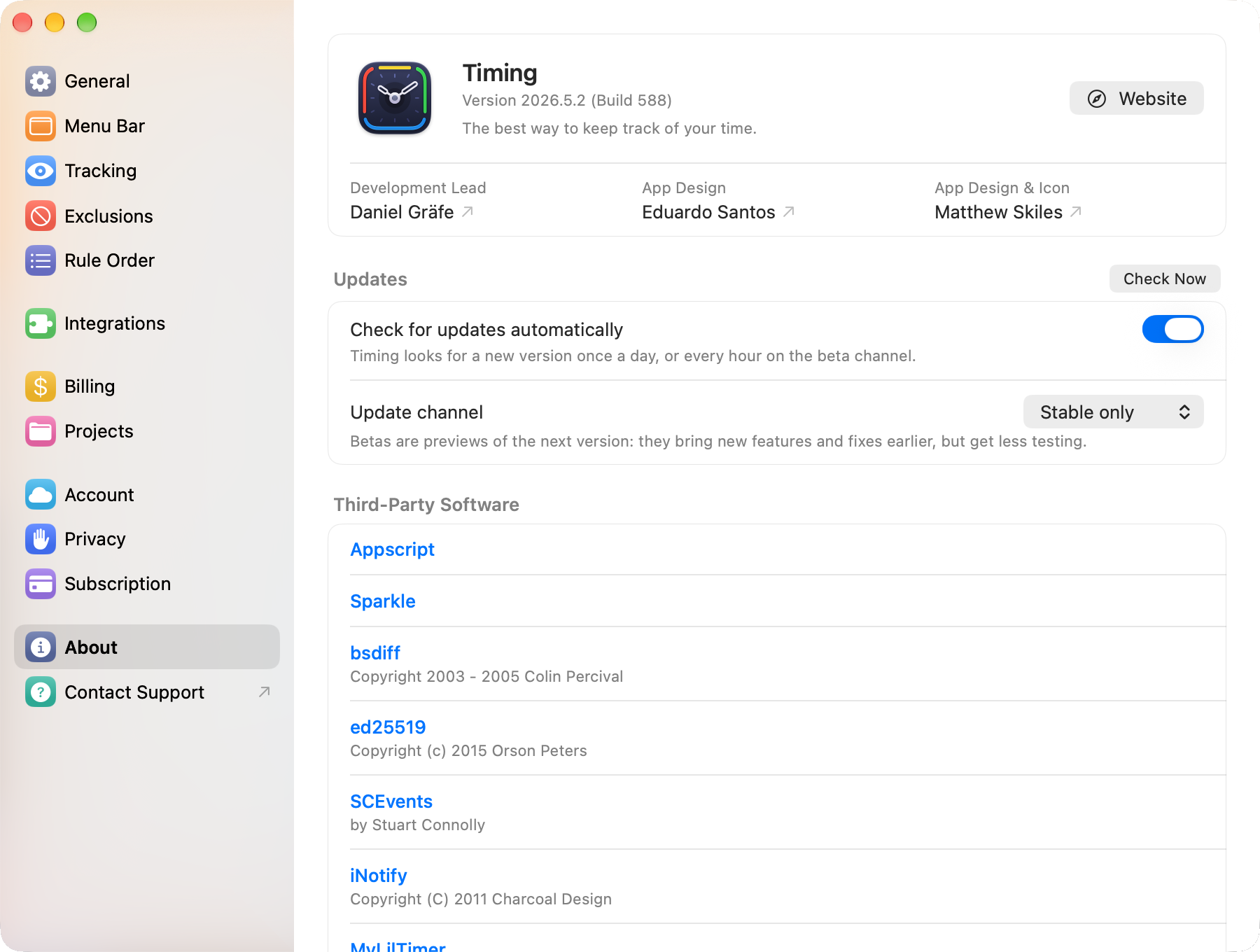
- Check for updates automatically: Timing looks for a new version once a day, or every hour on the beta channel. We recommend keeping this on, so you get important fixes, including security updates. Check Now looks right away.
- Update channel: Choose Stable only for regular releases, or Include betas for previews of the next version. Betas bring new features and fixes earlier but get less testing.
The pane also shows your version of Timing and lists the third-party software it uses. Contact Support, at the bottom of the sidebar, opens a support request to write to us.