
-
Becoming a Champ at Time Tracking

Time is arguably the most valuable currency in life. We are all allotted the same amount of it in a day, but we never know how much of it we will have in a lifetime. That’s why it is so precious.
In order to live a fulfilling life, we must be extremely cognizant of how we are spending our time each and every day.
Many of us would prefer to spend our time with family and friends, enjoying the simple pleasures of life, and feeding our brains.
However, we can’t do all those things without financial stability. Though money certainly isn’t the most important factor of life, it does award us freedom and security. Which is why time tracking is so important not just in terms of work, but our whole lives.
Maximizing productivity in our work lives means we are giving ourselves the opportunity to not work harder, but instead work smarter. Once we master this, we find we are able to spend less time making the income we need to live a balanced and rewarding life.
Read More → -
3 Common Mistakes Freelancers Make

Flexibility. Control. Being your own boss. Making your own schedule. Setting your own terms.
There are many advantages to being a freelancer in today’s uber-connected world. Telecommuting eliminates some of the daily grind and provides a landscape for more productive and efficient work. On top of that, having the freedom to pick and choose which clients to take on allows you to feel more invested in projects.
If you are currently freelancing, you aren’t alone. In fact, it’s estimated that the majority of the U.S. workforce will be freelance by 2027.
Read More → -
Keeping Data Secure as a Freelancer
In an increasingly digital world, most businesses are relying more and more on online tools for communication, file sharing, and content creation programs.
We email, type notes, design, use software, surf the Web, enter financial information, message coworkers and clients, and even conduct calls and video chats right from our desktops, laptops, or mobile devices all day long.
Our entire existence is hosted online, for better or for worse. Though it’s beneficial to see instant results or have immediate connections, having sensitive information online makes us vulnerable to security breaches.
For the most part, companies understand the severity of this and go to great (and sometimes costly) lengths to keep data safe.
And, as a freelancer, there are a number of steps to both safeguard your own information and be a trustworthy partner for your clients.
Free Download: Client Privacy ChecklistEnterprise Cybersecurity
With compromising hacks being uncovered more frequently, businesses and individuals alike are more concerned than ever about data security.
According to a Fortune article, which cites a report by the International Data Corporation, companies are expected to spend upwards of $101.6 billion on cybersecurity software, services, and hardware by 2020.
Enterprises employ entire IT teams who are responsible for being the digital gatekeepers of the company. They ensure that devices and data remain secure by utilizing firewalls, backup systems, and sophisticated software.
This level of awareness and prevention is great when it comes to securing on-site employees’ devices and networks, but with the rise in freelancers and remote workers, how can they feel confident that confidential information is being protected?
With the rise in freelancers and remote workers, how can business owners feel confident that confidential information is protected? Share on XOne great aspect of contracting work out to freelancers is that business owners don’t have to be on the hook to provide benefits to the worker—including resources like a laptop—which can significantly decrease the cost of overhead. On the flipside, they don’t have as much control when it comes to safeguarding information or files being shared.
As a freelancer, you don’t have a dedicated IT team to back you up (literally). However, you can assure your existing or potential clients that you also take cybersecurity seriously, and here are some ways to prove it.
Secure Connections
One of the perks of being a freelancer is the freedom to work anytime and from anywhere. Though it’s a luxury to have mobile flexibility, it’s important to be mindful of your Internet connections.
Popping out to your local coffee shop, hunkering down in a hotel room, or working on the fly in an airport can provide productive changes of scenery, but they also come with some security concerns.
It’s important to avoid unsecured public Wi-Fi networks, and instead only use password-protected connections.
No secure networks available? Having an unlimited data plan with your mobile provider will ensure you can hop on your personal Wi-Fi hotspot when needed.
VPN
You can also take it a smart step further and subscribe to a credible VPN (Virtual Private Network) service.
Many businesses use a VPN for their employees, which means they are working within a secure network connection that is only accessible on specific, confirmed devices.
What makes a VPN more protected than a regular, password-enable Wi-Fi connection? All the data transmitted within the VPN is encrypted, ensuring that even if a hacker were able to crack into the system, they wouldn’t be able to decipher the information found.
As a freelancer, you can also employ your own VPN system on your computer. Note that there are both free and paid services available, but it might be worth it to spend a little for added peace of mind.
Not sure if you want to spend money on your business? Read our last article, Why it’s Crucial to Invest in Your Business, to learn why you should be shelling out for some resources.
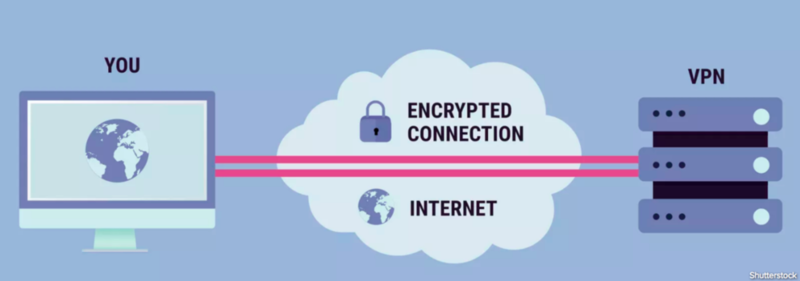
Source: Shutterstock via www.cnet.com
There are many VPN service providers on the market, but check out CNET’s round-up picks for 2018.
Email Encryption
Using a VPN is a great way to encrypt data within your network, but there are other forms of encryption as well.
There is specific software to encrypt email, which can be one of the easiest things for a hacker to get their hands on. Email is likely how you communicate with clients, passing along critical information and files. It also may be the host for other sensitive information, such as financial account details or tax forms.
Email encryption uses a complex algorithm and encryption key to make messages and attachments unreadable to those who aren’t intended to be a recipient. Better yet? Many encryption tools are free and may be an extension of your current web browser.
In addition, you may want to set up and monitor DMARC reports for your email domain, as those can tell you when e.g. someone is trying to send unauthorized emails from your domain.
Anti-Virus Software
If you’re reading this article, then we can probably assume you’re a Mac user.
Historically, Macs have been known to be more secure than PCs. But that has changed over the years. Though a Mac may be more difficult to target, there is still a threat. User error (such as downloading spam apps) can make your MacBook vulnerable to malware.
Especially for a freelancer who has the added responsibility of keeping a client’s data safe, it’s a good idea to install anti-virus software on your computer.
Luckily, our friends at Macworld have broken down the top security software for Macs today: The best Mac antivirus of 2018.
Secure Programs
You likely use a number of programs to work at an expert level. When dealing with sensitive or proprietary projects, use software or apps that also value cybersecurity.
Some apps may store your information online, or even sell it to third parties. Terrible, we know. Of course, a company that would put your privacy at risk is not one that you should partner with—whether in business or personally.
Here at Timing, we treat your privacy with the utmost respect, and would never compromise your data or the data of your clients. When using Timing, everything being tracked is kept locally right on your Mac, with nothing getting released or exported until you explicitly say so (let’s say, for example, for a client report).
We also give you the option to pause your time tracking within Timing, or even designate certain apps, websites, or file folders to not be tracked at all using our “Blacklist” feature.
Whether it’s with us or with another resource you use daily or sporadically, it’s critical to understand the privacy policies of each and every software program you consider.
Free Download: Client Privacy ChecklistFinal Thoughts
In addition to the measures above, it’s best practice to regularly update your devices to the newest operating system and switch up your passwords regularly.
We know you have a lot to juggle, and who can remember multiple passwords—especially if you are changing them frequently? Luckily, free apps like 1Password have your back, and can help keep all of your passwords in one, secure place (with only one ultimate password needed to access them all). As an alternative you can use open source password managers like Psono which offer flexibility without the cost, making them a great option for managing your passwords securely.
Taking the steps necessary to keep data safe doesn’t just place you in good standing with your clients and protect against risky leaks, but it also keeps your own personal information safe from hacks and identity theft.
You know what they always say: It’s better to be safe than sorry!
-
Why it’s Crucial to Invest in Your Business
It’s no secret that we all want to make as much money as possible—to fulfill our essential needs, and to offer us some freedom and security in life.
It’s been embedded in our brains since a young age that money makes the world go ‘round, and as we’ve grown older we can see just how much that rings true.
For most of us, this means that we want to keep a tight grip on any money coming in, and be mindful about how it eventually (and inevitably) slips from our grasp—especially for freelancers.
Without the safety and consistency of a salary, it’s understandable that you would want to reserve as much of that hard-earned coin as possible.
However, as a one-person show, you are essentially running a business. And, whether or not you have an LLC, personal website, or lawyer and accountant on speed dial, your work should be treated as such.
Just as the success of a large corporation depends deeply on the funds being invested back into the company, so does the success of your personal business.
In order to get the best results, it’s important to know where to focus your finances. Let’s get started.
Read More → -
Are You Ready to Freelance?

Have you noticed how much more common the concept of freelancing is today?
What used to be a term seemingly reserved for writers—reporters, columnists, copyeditors, etc.—has now transcended across nearly every industry.
(According to Merriam-Webster, the word “freelance” seems to have started in the early 1800s to describe a medieval soldier who would fight for the side willing to pay him the most. It was first mentioned in Ivanhoe, a novel by Sir Walter Scott.)
Especially in an increasingly digital world, the demand for developers, digital marketers, and tech whizzes has skyrocketed. Particularly when it comes to specialized needs, experts can find themselves in a position where they are being paid top dollar without having to make a full-time, on-site commitment.
Are you in a place in your career where going out on your own and “being your own boss” is something that feels right?
Read More →
